
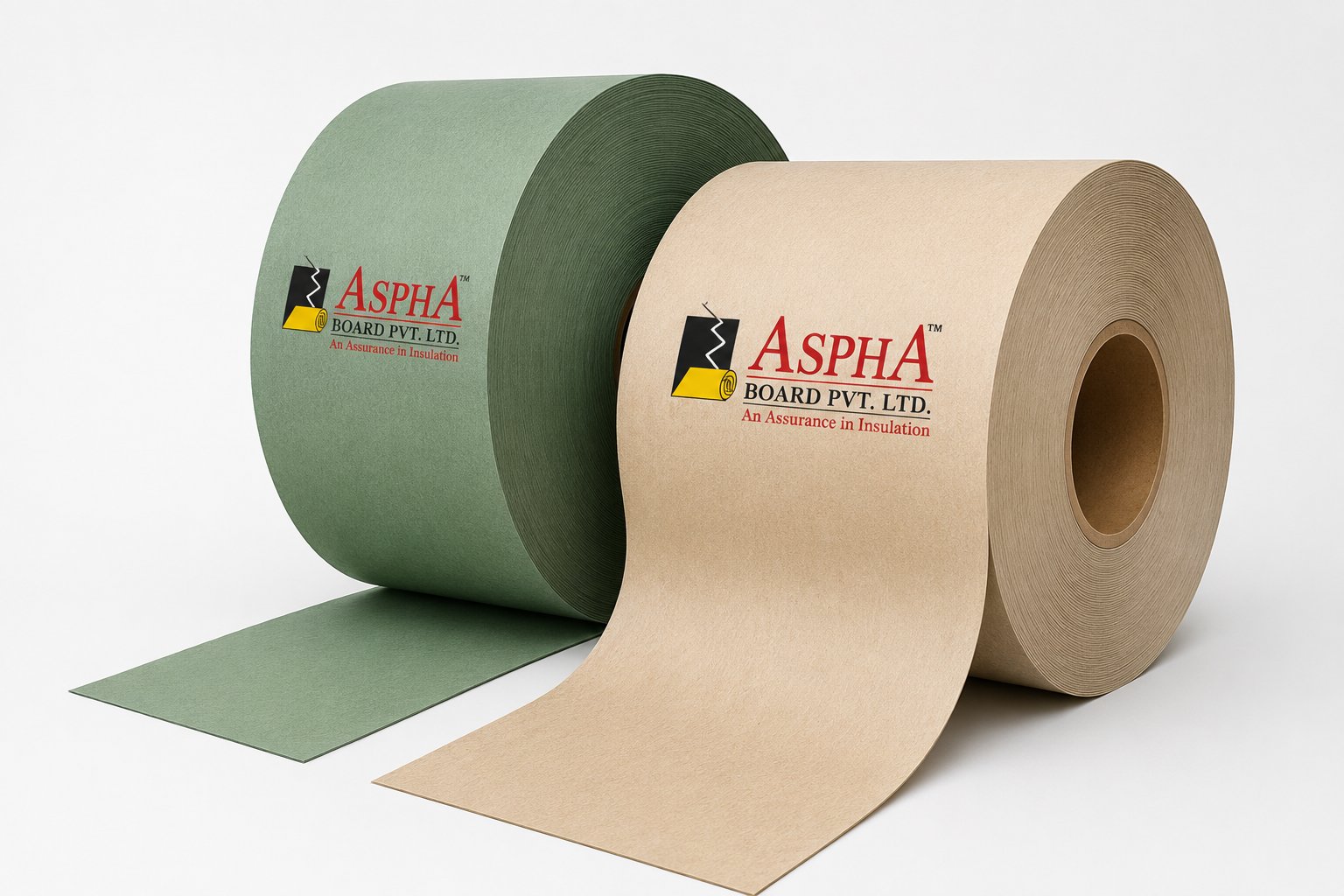
If you buy insulation material for transformers, motors or capacitors, you have almost certainly come across presspahn paper. It is one of the most widely used cellulose-based insulating materials in electrical equipment, yet buyers often struggle to compare grades, thicknesses and test values from different suppliers.
This guide explains what presspahn paper is, which properties matter, how to read a specification table, and how to choose the right thickness and shade. All values quoted here are for Aspha's PPEG presspahn paper, manufactured to IS 8570:1977 – Type D.
What Is Presspahn Paper?
Presspahn paper is a dense, smooth, cellulose-based electrical insulation paper. It is made from high-quality cellulose fibre and pressed to a high density so that it gives dependable dielectric strength, good mechanical strength and low moisture and ash content.
In the Indian trade it is also sold under names such as presspahn, press paper or electrical grade insulation paper. Aspha's version is supplied as PPEG in thicknesses from 0.10 mm to 0.50 mm (4 mil to 20 mil) on 40" (1000 mm) wide reels.
Why Presspahn Is Used for Electrical Insulation
Three properties explain why presspahn remains a first choice for oil-filled and dry electrical equipment:
- High dielectric strength, especially in oil. Presspahn absorbs transformer oil and, once impregnated, its breakdown voltage rises sharply compared with its value in air. For example, 0.25 mm (10 mil) paper has a minimum breakdown voltage of 2.1 kV in air but 12.0 kV in oil.
- Good mechanical strength. The paper can be wound, folded, cut and formed into slot liners, wraps and barriers without tearing during assembly.
- Clean, controlled chemistry. Low conductivity of aqueous extract, controlled pH and low mineral ash keep the paper from contaminating oil or degrading windings over time.
Presspahn Paper Specifications (PPEG, IS 8570:1977 Type D)
The table below shows the minimum values for each thickness, measured in our in-house laboratory.
| Thickness (mil) | Thickness (mm) | B.D.V. in air (kV, min) | B.D.V. in oil (kV, min) | Tensile MD (N/15 mm, min) | Tensile CD (N/15 mm, min) |
|---|---|---|---|---|---|
| 4 | 0.10 | 1.0 | 6.4 | 105 | 35 |
| 5 | 0.13 | 1.2 | 8.0 | 125 | 45 |
| 7 | 0.18 | 1.6 | 9.5 | 150 | 50 |
| 8 | 0.20 | 1.8 | 10.1 | 160 | 58 |
| 10 | 0.25 | 2.1 | 12.0 | 190 | 70 |
| 12 | 0.30 | 2.3 | 13.5 | 215 | 80 |
| 15 | 0.38 | 2.6 | 15.9 | 265 | 98 |
| 20 | 0.50 | 3.0 | 18.5 | 335 | 122 |
Properties common to all thicknesses:
- Density: minimum 1000 kg/m³
- Oil absorption: minimum 22% (at 1000 kg/m³ density)
- Conductivity of aqueous extract: maximum 3.0 mS/m
- pH of aqueous extract: 5.0 to 8.5
- Moisture content: maximum 8.0%
- Mineral ash: maximum 2.0%
Results depend on test conditions, so always confirm values against your own acceptance standard and request a test report with your batch.
Natural (Undyed) vs Green Presspahn
Presspahn is available in two shades, and the choice is driven by application rather than appearance.
Natural (undyed) is used in transformers, capacitors, electrical motors and gaskets.
Green is used as backing paper for lamination with polyester film for Class E insulation, and as stand-alone insulation in electrical motors. Green paper can be custom-manufactured to your specification and required thickness.
Where Presspahn Paper Is Used
- Power transformers: barriers, spacers and wraps
- Distribution transformers: layer and winding insulation
- Electrical motors: slot liners and phase insulation
- Capacitors: dielectric and wrap insulation
- Pumps and industrial equipment: winding insulation
- Gaskets: sealing and insulating gaskets in electrical assemblies
How to Choose the Right Thickness
Thickness is a trade-off between dielectric strength and workability. Use these as practical starting points, and always defer to your design drawing or customer specification:
- Start from the voltage requirement. Check the minimum breakdown voltage in oil (or air) needed between conductors or between winding and core, then pick the thinnest grade that meets it with your safety margin.
- Consider the shape. Tight bends and small slots favour thinner grades. Flat barriers and spacers can use thicker paper.
- Check tensile strength. Machine winding and insertion put stress on the paper. The machine direction (MD) is always stronger than the cross direction (CD), so orient the paper accordingly.
- Confirm reel width and tolerance. Our standard reel width is 40" (1000 mm), and each thickness has its own tolerance (for example 0.25 ± 0.02 mm for 10 mil).
Presspahn Paper vs Leatheroid Kraft Paper (KPEI)
Buyers often ask how presspahn differs from leatheroid paper. In our range:
- Presspahn (PPEG) is a speciality grade made to IS 8570:1977 Type D, with defined oil absorption, breakdown voltage in oil and extract limits. It is accepted for transformers, capacitors and motors, and we have begun exporting it.
- Leatheroid kraft paper (KPEI) is a commercial-grade product made to company standards in 5 to 20 mil. It suits core and slot insulation in motors, pumps and chokes, and the repair of transformers and motors.
If your equipment must meet a national or customer standard, specify presspahn. If you need cost-effective insulation for general slot and core use or repair work, leatheroid kraft paper (KPEI) may be enough.
Buyer's Checklist for Presspahn Paper
Before placing an order, ask your supplier for:
- The applicable standard (for example IS 8570:1977 Type D)
- A test report showing oil absorption, density, breakdown voltage, tensile strength, pH, conductivity, moisture and ash
- Thickness tolerance and reel width
- Shade (natural or green) and any custom requirement
- Batch traceability and the supplier's in-house quality control process
- Minimum order quantity, lead time and dispatch location
Frequently Asked Questions
What is presspahn paper used for?
It is used as electrical insulation in power and distribution transformers, electric motors, capacitors, pumps and gaskets.
What thicknesses does presspahn paper come in?
Aspha PPEG is available from 0.10 mm (4 mil) to 0.50 mm (20 mil): 4, 5, 7, 8, 10, 12, 15 and 20 mil.
What is the difference between natural and green presspahn?
Natural (undyed) paper is used in transformers, capacitors, motors and gaskets. Green paper is used as backing for lamination with polyester film for Class E insulation and as stand-alone motor insulation.
Which standard does Aspha presspahn paper follow?
PPEG is manufactured in compliance with IS 8570:1977, Type D.
Is there a minimum order quantity?
No. We accept enquiries for any quantity, from small repair orders to regular bulk supply.
Do you export presspahn paper?
Yes. We have started exporting PPEG internationally.
Buy Presspahn Paper from a Manufacturer Since 1988
Aspha Board Private Limited has manufactured speciality papers at its plant in Shirur, Pune for nearly four decades, with an in-house testing laboratory and quality control from raw material to dispatch.
See the full Presspahn Paper (PPEG) specifications, learn more about us, or request a quote for any quantity. You can also call +91-9820476938 or email info@aspha.com. We respond within 1 to 2 business days.